Most Small Businesses Never Sell
Say you own a small business you want to sell. Not a $40 million supermarket chain, but something the SBA actually means when it says “small”: a restaurant doing a couple million a year, an HVAC company, a service business with a dozen people on payroll. The kind of thing that gets priced as a multiple of Seller’s Discretionary Earnings, usually 1.0 to 2.5x. So you decide to sell and reach out to a well-known local business broker. The part nobody mentions before you sign is that 70 to 80% of listings like yours never transact. Not “sold for less than we hoped.” Never sold. The listing goes stale, gets pulled, and the business either grinds on under an owner who wanted out two years ago or just shuts down, because it turns out there was no exit after all.
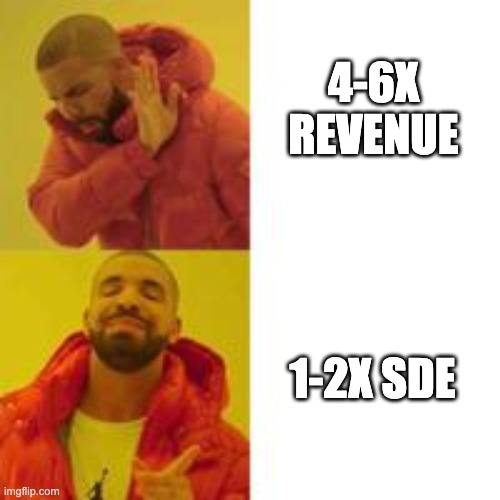
I’ve spent enough time examining local listings that the failure rate doesn’t surprise me. Businesses show up priced at 4 to 6 times revenue, multiples that belong on a venture-backed SaaS unicorn, not a landscaping company. Real small business revenue multiples run about 0.42 to 1.2x, with the more common SDE-based pricing landing around 2 to 3 times earnings. Do the math on that gap: a business doing $2 million in revenue asking 6x is listed at $12 million. What it will actually fetch, priced off SDE the way lenders and buyers actually underwrite it, is somewhere in the low seven figures, often well under $1.5 million. That’s not an aggressive ask that gets negotiated down. That listing was dead the day it went up, and even the realistically priced ones only close at 85 to 86% of asking on average. A 6x listing sits for a year (or more) and gets pulled after a lot of people waste a lot of time on it.
Compare the situation to real estate: an overpriced house that sits unsold for a year is a bad time for the seller but it doesn’t materially impact the true value of the house. Cut the price, wait out the market. Worst case the place sells for roughly what it was worth the year before. Value is easy to determine and split between land and structure, and neither of those evaporates because a listing went stale. A business has no such floor: its value lives in the cash flow, which depends on an owner who’s still showing up and a team that’s still putting in the work because they believe there’s a future. Stretch the listing out long enough and the number can actually hit zero, because time is corrosive and decaying value is unforgiving to the sales process.
Which is why the reason the owner is selling matters more than it ever would for a house. Retirement accounts for maybe half of all business sales, leaving the other half selling because of burnout, health problems, a divorce, a partner dispute, or just being done. Roughly a quarter of small business owners report being burned out right now, and burnout is exactly the state of mind that pushes a nine-month listing from annoying to unbearable. An owner who’s worn out or dealing with a health scare isn’t investing in the business during the sale process. He’s coasting. A stagnant business isn’t neutral while that’s happening, though. Flat revenue against rising labor, rent, and insurance costs is a business quietly going backward, and businesses stagnate specifically because nobody kept investing in what made them grow in the first place. An owner who’s already checked out isn’t the guy who reverses that.
The clock works against the business a second way. Sale processes don’t stay secret, ever. Word leaks through diligence requests, buyer site visits, and a hundred small changes in how the owner starts acting, and once the staff figures out the business is for sale, the good ones start updating resumes. Losing a key employee mid-sale can cost 50 to 200% of that person’s salary to replace, and they can walk out with the client relationships or institutional knowledge that made the business sellable in the first place. Every month a listing drags on is another month for a key employee to bail, a lease to get worse, a competitor to poach a customer, or the market to shift under the whole deal. A house sitting on Zillow doesn’t have any of that happening underneath it. A business does, constantly, whether the broker is watching or not.
A chunk of that failure rate is preventable. And a good chunk of the blame sits with an industry that’s supposed to prevent it.
Business brokers, as a category, are all over the map. Some run a real process: financials, a proper valuation, an OM that actually represents the business. A lot of them just want the listing signed. They’ll take a business to market at whatever fantasy number the owner wanted, hand over a thin write-up, and let it marinate for months while buyers scroll past. Broker review quality varies enormously across the industry, and a broker paid on percentage isn’t exactly incentivized to talk a seller down from an unrealistic number. A good broker does the opposite on every count: runs real comps instead of nodding along with whatever number the owner wanted to hear, pre-qualifies buyers on financing before shopping the deal around and burning the seller’s confidentiality on tire-kickers, and builds an OM detailed enough to survive the buyer’s diligence instead of getting embarrassed by it three weeks later. That version of the job exists. It’s just rarer than it should be.
Which is how you end up with buyers doing the broker’s job for them. (Ask me how I know) Buyers in this market are repeat players, mostly. A guy buying his third HVAC company knows exactly what 2x SDE means and has read a hundred OMs. The seller has sold exactly one business in his life: this one. Sellers routinely blend what the business is worth with what it cost them personally. That means pricing in twenty years of nights and weekends and missed family events into the number they expect at closing. The market doesn’t pay for that. So the buyer, not the broker, ends up walking the seller through comparable sale multiples and explaining why the number in his head isn’t the number a bank will lend against. That’s a rough spot to negotiate from and if you’re doing that as a seller you’ve already lost the room.
Then there’s the stuff that will absolutely torpedo any deal. Owner dependency is the big one: if the business can’t function without the seller, a buyer isn’t buying a business, he’s buying a job, and he can go get one of those without a note attached. Customer concentration is close behind. Once a single customer accounts for 20% or more of revenue, plenty of buyers and their banks won’t even take a meeting, and the ones who don’t will structure around it with earnouts and bigger holdbacks, meaning less cash at closing. Add in books that commingle the owner’s personal spending with the business’s, a lease about to expire, or a couple of key employees who could walk off with the client list, and you’ve got a business that’s profitable today and nearly impossible to sell.
Underneath a lot of that sits one root problem: sellers don’t know their own numbers. Six in ten small business owners aren’t confident in their own accounting, and plenty are still running the operation on pen & paper, or a spreadsheet nobody’s reconciled since Clinton was in office. That shows up on both sides of the ledger: personal costs buried in the P&L, below-market rent to a landlord who happens to be the owner, a top line drifting down for two or three years with no explanation attached. A steady revenue decline alone is one of the biggest deal killers in due diligence, sometimes cutting achievable offers to 40 to 50% of peak value. Both failure modes have the same tell: a number that looks fine on the listing and falls apart the moment a buyer’s diligence team starts asking questions.
Most of these problems are fixable, starting well before the listing ever goes up.
Separate personal finances first, and do it for real: dedicated business accounts, payroll for the owner instead of ad hoc draws from the till, a business credit card instead of the owner’s Amex running through the P&L. A bank underwriting an SBA loan wants twelve clean trailing months, and books where the owner’s personal life isn’t tangled up in the business’s.
Once the books are clean, do the add-back math honestly, and don’t stop at the owner’s salary and personal expenses. Get the phantom items too. If the owner also owns the building and charges below-market rent (or no rent), a buyer doesn’t inherit that discount. Same logic applies to relationships: if half the client list only sticks around because they’ve personally known the owner for fifteen years, that’s not transferable value, and pretending otherwise just sets a buyer up to fail.
The single highest-leverage move a seller can make before listing, and increasingly a standard expectation even for SBA deals, is commissioning a sell-side quality of earnings report. It’s an independent look at the same numbers a buyer’s diligence team would produce anyway, except it happens on the seller’s timeline instead of the buyer’s, and the ugly surprises get found and explained before an LOI gets signed instead of after. A credible QoE report also gives a serious buyer something to start from instead of starting from zero, which will get you a lot closer to closing the deal.
None of this guarantees a sale. But the gap between a business that sells and one of the 70 to 80% that doesn’t usually comes down to whether the paper trail matches the headline, not the business itself.