Synthetic Oil Isn't What You Think
Show of hands: who assumed “full synthetic” motor oil meant something that never came out of the ground? I did, for about twenty years, buying the good stuff at the auto parts store, right up until I found out this week that the label is mostly a legal technicality now, not a chemistry claim.
Synthetic oil used to mean something specific: a base stock built molecule by molecule instead of pumped out of the ground and refined. The push came out of World War Two, when German tank crews learned the hard way that conventional lubricants gel into sludge at Eastern Front temperatures, a detail historians count among the reasons German armor stalled outside Stalingrad. Germany tested more than 3,500 synthetic esters trying to fix it. After the war the same chemistry moved into jet engines, since nothing pulled from crude could survive a turbine at altitude. AMSOIL brought the first API-approved synthetic motor oil to market in 1972, Mobil followed with Mobil 1 in 1974. Both were polyalphaolefins, PAO, built through actual synthesis, not squeezed from a well.
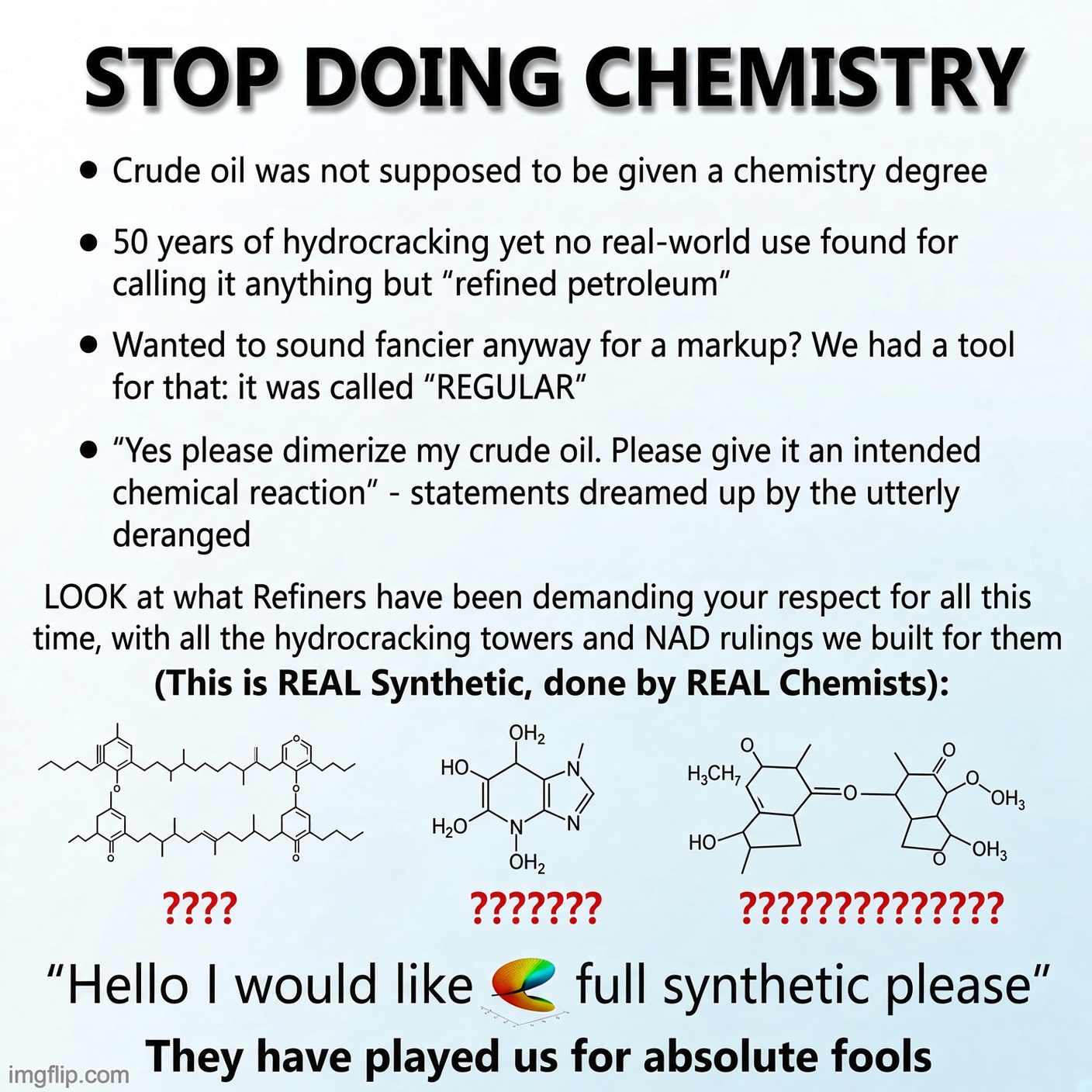
That held up as an honest word for about 25 years. In 1999 Mobil went after Castrol for calling Syntec “full synthetic” when its base stock was really hydrocracked and isomerized conventional crude, what the industry calls Group III. The National Advertising Division sided with Castrol, reasoning that Group III oil goes through “an intended chemical reaction” on its way out of the refinery, so it counts. The hydrocracking involved is the same process every refinery already runs to make regular motor oil, just tuned a little harder. The American Petroleum Institute dropped the word “synthetic” from its own certification standards afterward, since it had no way to certify a marketing claim. Every major refiner pivoted to Group III within a few years. It costs less to make, and the 1999 ruling made it legal to sell under the name the expensive stuff used to own.
This is bait-and-switch advertising wearing an oil-change ad, and the playbook is the same everywhere: find a word that sounds like a promise, then redefine the product until it clears the bar instead of the other way around. Coal got “clean.” Natural gas got “the bridge fuel,” a bridge now in its third decade of construction with no far shore in sight. Leather has its own version baked right into the name: full-grain and top-grain are the real hide, and a couple of grades below that sits “genuine leather,” which sounds like an assurance and actually means heavily processed hide scraps from the bottom of the tannery, one step above material that isn’t leather at all. Food labeling runs the same play. The FDA has never legally defined “natural” on a package, and its informal standard only checks whether something artificial got added after the fact, so high fructose corn syrup and genetically modified ingredients both clear the bar as long as nothing extra got mixed in later. Group III oil didn’t get more synthetic between 1999 and now. Leather didn’t get more genuine. Food didn’t get more natural.
Meanwhile the crude underneath all of it has had a rough month. Brent crude climbed to roughly $97 a barrel in early September as the US and Iran traded strikes around the Strait of Hormuz, the chokepoint that normally carries about a fifth of the world’s oil, and daily tanker traffic through it dropped to around 10 ships. Saudi Arabia had been routing more crude through the East-West pipeline to bypass Hormuz, 745 miles across the peninsula to the Red Sea, until drones traced to Iraq’s Maysan province hit it in two places on September 13 and Saudi Arabia shut it down. That pipeline was carrying 4 to 5 million barrels a day. The Red Sea terminal it feeds has roughly five to seven days of storage to cover the gap while repairs, estimated at five to six weeks, get underway.
That is the kind of month that turns up at Costco. Kirkland Signature full synthetic is now capped at two ten-quart jugs per customer per week, Mobil 1 at five, and the Kirkland jug itself went from around $30 to $58. The reason has nothing to do with PAO or Group III: refineries currently make more money turning a barrel of crude into gasoline and diesel than into base oil, so base oil is the first thing to get squeezed when the barrel itself is under a drone campaign.