Force Majeure
Table of Contents
On Thursday Oracle sent a force majeure notice to the developer of Project Jupiter, the 2.45 GW Stargate campus in southern New Mexico. Force majeure is French for “superior force.” It came into contract law through the Napoleonic Code, which borrowed it from the Roman vis major, and it’s the clause that excuses you when something outside your control (war, flood, the English-law favorite “act of God”) keeps you from holding up your end of a contract. In this case the superior force is a 17.8 mile gas pipeline the state of NM refuses to approve.
The facts are pretty mundane. The datacenter campus needs gas to run its on-site power, and the company Energy Transfer was going to build the spur line to deliver it. The New Mexico State Land Office rejected the pipeline’s rights-of-way in March and again in July, with the land commissioner citing emissions and the strain on local water resources. The route got redrawn across federal land, and the date of first-gas slid from mid August to February 1 next year. The fuel cell air permit is also still pending state approval in November. The Jupiter project was designed to make its own power with nat gas fuel cells instead of waiting on the grid, which is the behind-the-meter workaround I said back in May wouldn’t save the near-term buildouts. It still needs gas delivered, the gas needs a pipeline, and the pipeline needs a permit which is the point of pressure for groups opposed to datacenters.
Oracle says Jupiter “remains on our planned schedule.” The notice lets Oracle delay lease payments if the campus misses its 2028 launch date. That’s the whole point of it. Oracle is getting its paperwork in order so that if the building is late, the cost of being late lands on somebody else.
Who’s holding it
The somebody else is Blue Owl Capital, which owns Stack Infrastructure, the developer on the project. Blue Owl has roughly $3 billion of equity in Jupiter, and the way these deals are built, its returns stay low during construction and only step up once the tenant is paying full rent. A delay pushes out the payday and extends the period where Blue Owl earns the least on the most capital outlay.
Below Blue Owl sit the lenders, and they’re mostly banks. About $18 billion of construction loans was arranged last November by a group of roughly 20 banks led by SMBC, MUFG, BNP Paribas and Goldman Sachs, at about 2.5 points over SOFR. The plan was to sell most of it on to institutional investors. That sale, however, has stalled and syndicate banks are now quoting the loans at 89 to 91 cents on the dollar while holding more of them than they planned to. That’s ten points below par on a construction loan with an investment-grade tenant, and it puts the risk on bank balance sheets, similar to where it sat in 2008 and the Great Financial Crisis (GFC). Oracle closed down 3.5% Thursday and kept sliding Friday, down more than 6% for the week. Blue Owl trending nearly as bad for the week.
Now look up the chain instead of down. Oracle’s tenant for Jupiter is OpenAI, which is roughly half of Oracle’s $638 billion contract backlog. That concentration is a big part of why S&P cut Oracle to BBB- in July, one notch above junk, while projecting fiscal 2027 capex of $90 to $95 billion and a free cash flow hole of around $42 billion. Oracle’s credit default swaps hit a record near 200 basis points the same month. In May I cited OpenAI’s own projection of a $14 billion loss for all of 2026. It posted $21.6 billion in operating losses in the first half alone. So the chain runs: an unprofitable AI lab, leasing from a stretched hyperscaler borrowing to build, leasing from a private capital firm, financed by banks that can’t offload the paper. Each link has a contract that says the risk belongs to the other guy.
Blue Owl was already wobbling
This isn’t Blue Owl’s first bad quarter. Its stock peaked at $25 in January 2025 and was under $8 by April of this year, after investors asked to pull $5.4 billion from two of its private credit funds in a single quarter. These funds don’t trade on an exchange. The only way out is to ask Blue Owl to buy your shares back, and the fund gets to decide how much it pays out each quarter. In the first quarter, investors holding 22% of the flagship fund and 41% of the tech fund asked for their money back. Blue Owl paid out 5% and told everyone else to wait, and it’s kept that limit in place since. The second quarter wasn’t much better, with 19% and 38% still trying to leave. New money from wealthy individuals, the retail channel that fed the private credit boom, dropped from $4.4 billion to $1.7 billion year over year.
Meanwhile the data center side kept growing, which is how the firm pitched it to shareholders: credit outflows offset by digital infrastructure. Back in December Blue Owl walked away from funding Oracle’s $10 billion Michigan campus when lenders wanted tighter terms. This month it floated plans for a roughly $6.5 billion public data center REIT seeded with its own assets. And on Wednesday, the day before the notice, Blue Owl affiliates sold $1.1 billion of junk bonds at 9.25% against a Virginia campus leased entirely to CoreWeave. That’s about 2.7 points more than other bonds with the same rating. S&P rated it BB- and named the problem in one line: “Exposure to a single, speculative-grade tenant remains the key risk.”
Read those together. A firm whose retail investors are lined up at the exit is packaging its data centers for public-market buyers, and borrowing at high-yield rates against a single neocloud tenant, while its biggest hyperscaler tenant files paperwork to make late rent someone else’s problem. Those are all ways to move data center exposure off Blue Owl’s books, and they’re happening in the part of the business that was supposed to be growing.
Climbing onto the roof
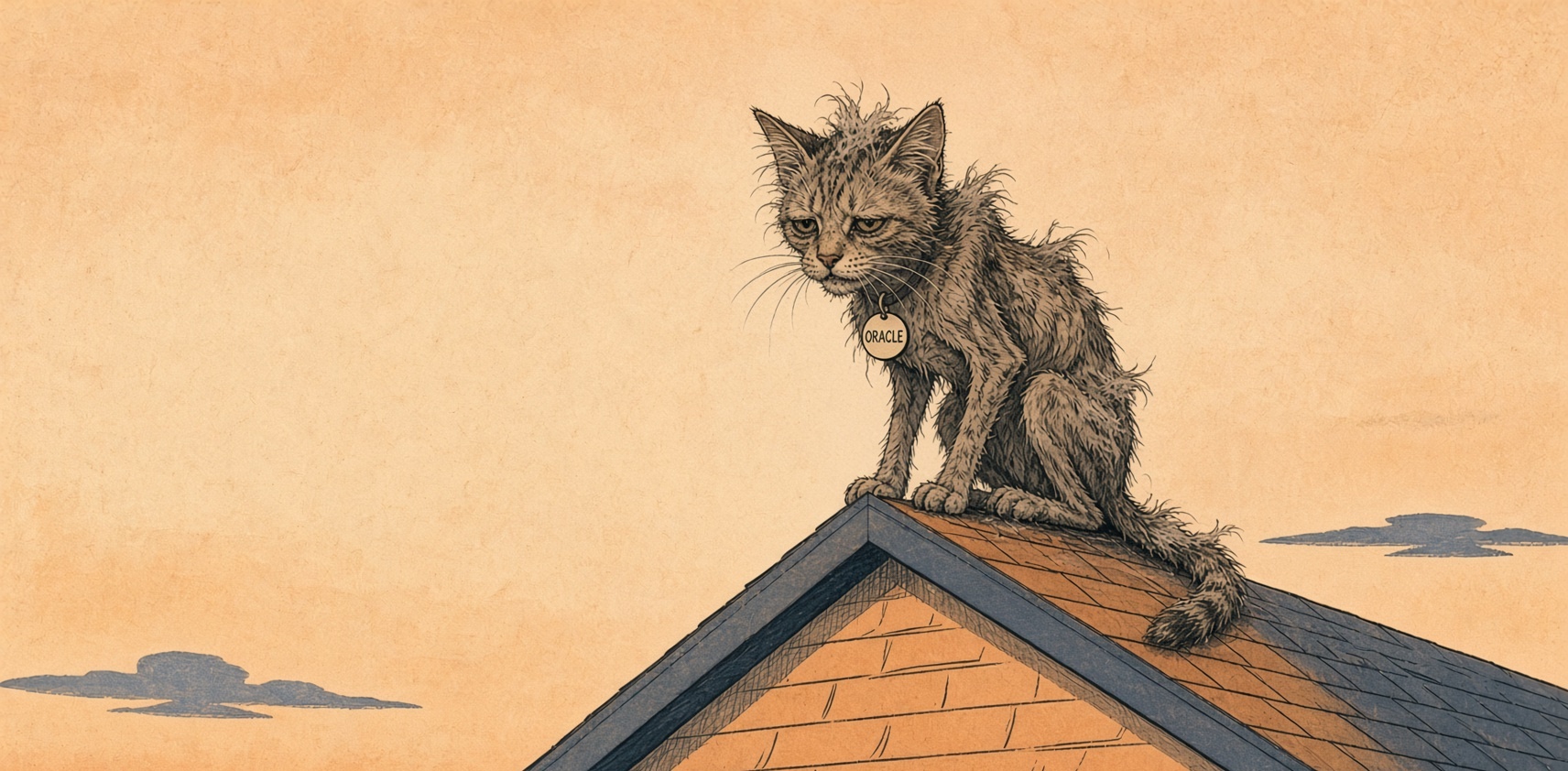
There’s an old joke about a guy who leaves his cat with his brother while he’s out of town. He calls to check in and the brother tells him the cat died. The guy is furious. You don’t just drop that on someone, he says. First you tell me the cat’s on the roof and won’t come down. Next time I call, the fire department couldn’t reach it. Then it fell. Then the vet did everything he could. The brother apologizes. A week later the guy calls again and asks how Mom’s doing. Long pause. “She’s on the roof.”
Nobody in this chain has defaulted yet but I suspect the cat might be climbing up to the roof.
The 2008 GFC got delivered the same way, one call at a time. In August 07 BNP Paribas froze three funds because it couldn’t put a price on the mortgage paper inside them. Seven months later Bear Stearns got sold to JPMorgan for $2 a share (later bumped to $10) with the Fed backstopping the bad assets. Lehman filed six months after that. Each step looked contained on the day it happened.
Lehman wasn’t the biggest bank on Wall Street. It mattered because everyone was on the other side of a trade with it. The day after it filed, the Reserve Primary Fund broke the buck because it held Lehman paper, and short-term lending froze across the whole system. If, like most, you weren’t paying attention back then check out the 2011 movie “Too Big to Fail” which tries to connect the dots in a way that’s half entertainment and half modern horror.
If this plays out like 08, Oracle is the closest thing to a Bear Stearns, minus the overnight funding problems. It’s already rated one notch above junk with something like $167 billion of debt, and another downgrade forces every fund that can only hold investment grade to start (forced) selling. That would hurt. But add up the contracts that end at OpenAI. It’s half of Oracle’s backlog, the anchor tenant for SoftBank’s SB Energy (which just postponed its $50 billion IPO when buyers balked at the price), and the reason the Jupiter project exists at all. If OpenAI misses a payment, every one of those contracts gets tested in the same week, and the collateral underneath is GPUs losing value on the curve I modeled last month.
Oracle’s got a foot on the ladder. Somebody should check where OpenAI is.